Body Entrapment

One type of river accident is known as body entrapment. When a person’s body comes into contact with an underwater obstacle, such as a submerged tree, the strong force of the current can push the person against the obstacle, making it impossible to move and potentially leading to drowning.

In our simulation with a flow velocity of 2 m/s, the results showed that the human body was pressed against the obstacle by a force equivalent to approximately 200 kgf (1,960 N).
Graduate Program Information Session (Earth and Environmental Engineering Course) to Be Held

Nakamura Laboratory welcomes graduate students from the Earth and Environmental Engineering Course (primary affiliation) and the Civil Engineering Course (secondary affiliation).

An information session for prospective graduate students of the Earth and Environmental Engineering Course will be held on Saturday, May 17.

If you are interested in joining our laboratory, we encourage you to attend!

University Website: Graduate Program Information Session

Visualization: Tsunami Flow into a Narrow Alley

As part of a lecture, we conducted a simulation of a tsunami entering a narrow alley. The simulation assumes that a tsunami with a wave height of 2 m enters the alley from both sides.

Numerous objects on the street, such as vending machines and bicycles, are swept along by the tsunami and may collide with people. Such collisions are considered to increase the dangers posed by tsunamis, and we plan to continue investigating these risks in our research.

Recent Research Highlights

Some locations in rivers are known as dangerous spots, where water-related accidents occur repeatedly. One possible cause is the formation of hazardous vortices and downward currents in areas where rivers bend sharply or where the riverbed suddenly becomes much deeper.

Our laboratory is initiating a research project to evaluate drowning risks at these locations. Using a coupled human–fluid simulation model, we aim to reproduce actual hazardous river locations in a computer simulation and assess the risks they pose to people in the water.

Laboratory Visit

Undergraduate students visited our laboratory to gain hands-on research experience. The participating students formulated their own research questions and conducted simulations using DRUM, the coupled human–fluid simulation model developed in our laboratory.

They were interested in investigating what would happen to a person walking on stairs when a tsunami strikes. The video shows a simulation of this situation with a tsunami wave height of 5 m.

The fresh and creative perspectives of young students, unconstrained by conventional ideas, often inspire us to explore new research topics.

We always welcome visitors who are interested in our laboratory and research activities. Please feel free to contact us!


Visualization

Water-related accidents often occur near waterfalls. Although the forcefully falling water may appear refreshing and inviting, the flow structures formed in the plunge pool and their associated dangers are not yet well understood.

We have recently begun a research project to evaluate these risks by applying our coupled human–fluid simulation model to flows in waterfall plunge pools.

The simulation shown below is only a preliminary trial conducted to examine the computational scale required. In future work, we will work toward reproducing the actual topography and hydraulic conditions of real waterfalls.

Visualization

We are conducting numerical simulations to assess the risks posed by snow avalanches on steep slopes. The simulation shown below analyzes the motion of a human body caught in an avalanche on a steep slope inclined at 45 degrees. In this simulation, the avalanche is modeled as a non-Newtonian fluid.

Received the Hydraulic Engineering Paper Encouragement Award

A paper written last year by a second-year master’s student and published in the Journal of JSCE, titled “Injury Risk Assessment for Falls into Water from Heights Using Coupled Human–Fluid Numerical Simulations,” has received the Hydraulic Engineering Paper Encouragement Award.

This research was initiated based on an idea proposed by the student. The study evaluates the risks associated with falling into water from elevated locations, such as bridges. We hope that the findings will contribute to preventing such accidents in the future.

Congratulations on this achievement!

JSCE Conference on Hydraulic Engineering 2023 in Osaka

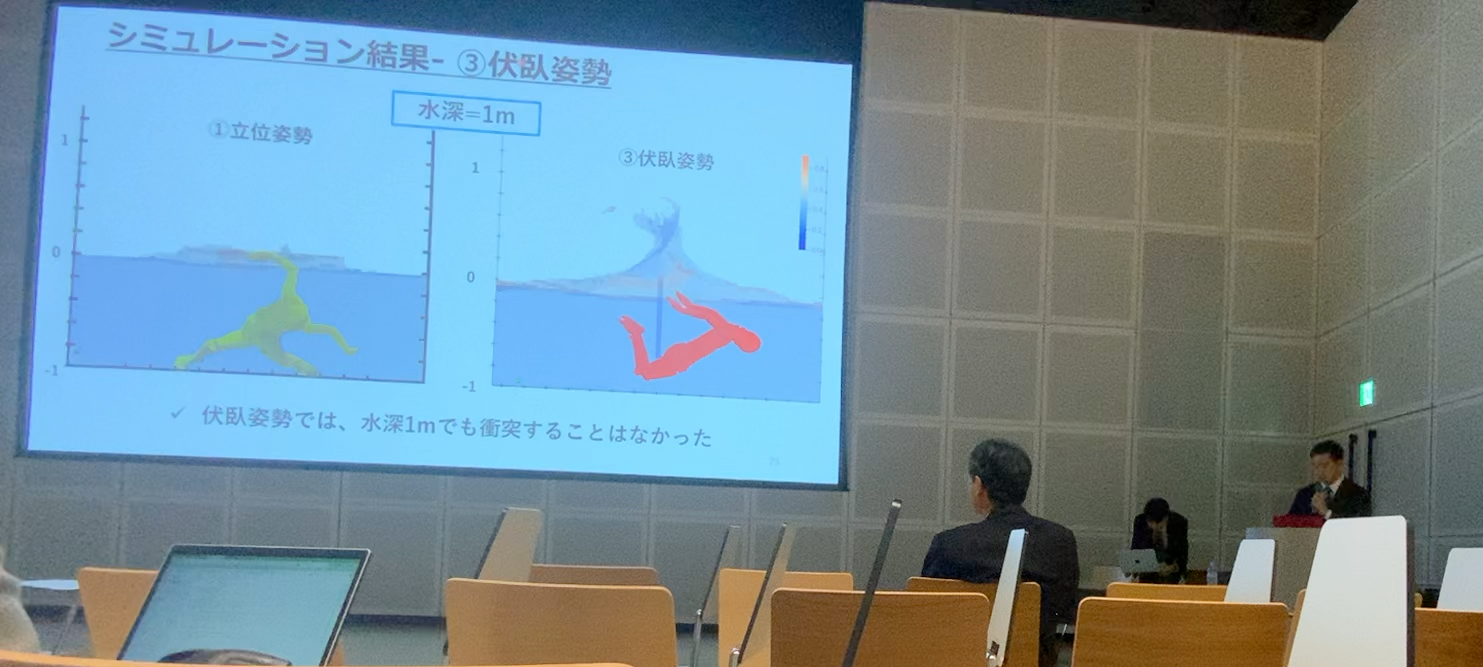
The JSCE Conference on Hydraulic Engineering was held at Osaka University’s Nakanoshima Center.

A second-year master’s student from our laboratory gave a presentation on numerical simulations assessing the risks of falling into water from heights.

Since the Hanshin Tigers had finally achieved their long-awaited championship victory that year, the topic was particularly timely, considering the tradition of fans celebrating by jumping into the Dotonbori River in Osaka!