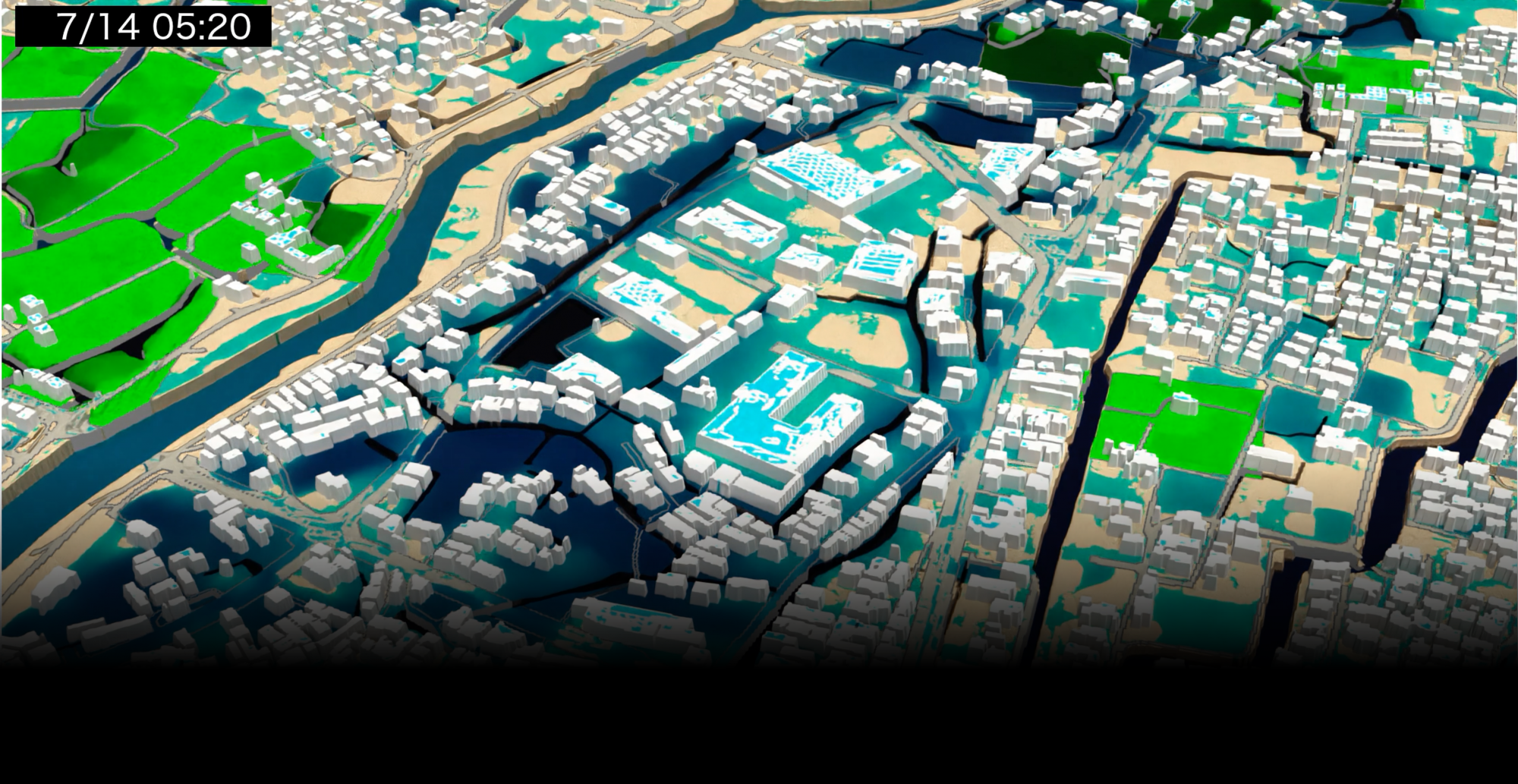
Unlike laboratory water tanks, natural aquatic environments do not have clearly defined boundaries. Research on aquatic environments sometimes requires simulations covering vast areas extending over tens to hundreds of kilometers. In addition, environmental phenomena may develop as a result of processes occurring over long periods, ranging from several months to several years, such as seasonal changes between wet and dry seasons. In general, simulating such large areas over extended periods requires enormous computational time.
Furthermore, to utilize numerical simulations for disaster prevention, such as predicting tsunami wave heights, simulations must be completed within the limited time between the occurrence of an earthquake and the arrival of the tsunami at the coast.
Therefore, high-speed simulation models capable of completing calculations within a short time are sometimes essential for research on aquatic environments. Our laboratory focuses on General-Purpose computing on Graphics Processing Units (GPGPU) as a technique for accelerating numerical simulations and develops various high-performance simulation models.
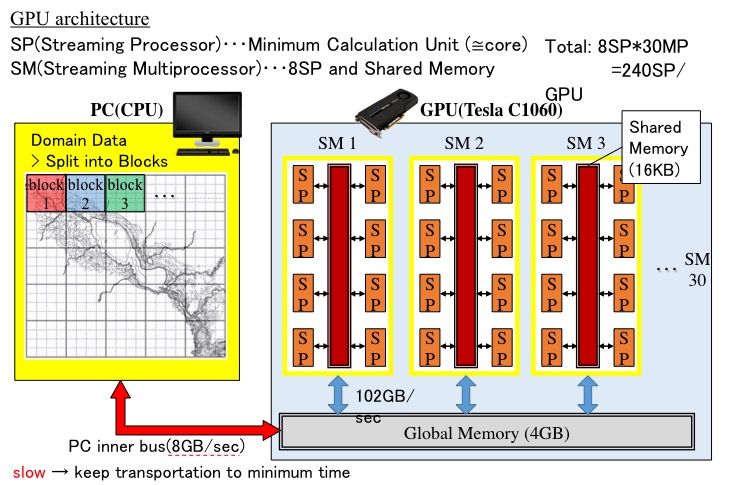
GPGPU is a computing technology that utilizes Graphics Processing Units (GPUs), originally designed for rendering images on computer displays, for scientific and engineering simulations. Modern GPUs contain thousands of computational units, which are somewhat analogous to CPU cores. Through specialized parallel programming, these computational units can work simultaneously on a single simulation, significantly reducing computational time.
Although the achievable speedup depends on the numerical methods and problems being analyzed, our GPGPU-based simulations have achieved performance improvements ranging from approximately several tens to one hundred times compared with conventional CPU-based implementations.
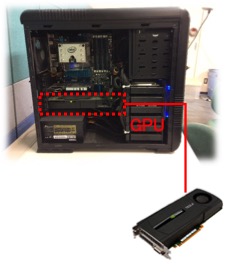
Example of a GPU (NVIDIA Tesla)
Internal Architecture of a GPU (High-Speed Computation Using Thousands of Streaming Processors (SPs) Within the GPU)
Example of a GPGPU-Based Simulator (Simulation of Tsunami Propagation Following the 2011 Great East Japan Earthquake)
The first tsunami wave reached the coast approximately 30 minutes after the earthquake. While conventional PC-based simulations required about five hours to reproduce the tsunami propagation, the use of GPGPU technology reduced the computational time to just a few minutes.
This significant acceleration enables simulations with finer topographic resolution, allowing us to capture detailed tsunami behavior, such as local increases in wave height caused by variations in water depth and wave propagation around peninsulas.
GPGPU-Based Flood Simulation Model
This example demonstrates a flood simulation of the lower Senegal River basin in Africa. The model enables the analysis of flood inundation and flow dynamics over a vast area extending more than 100 km, with a spatial resolution of 30 m. Using GPGPU technology, the simulation of flood inundation over an entire year can be completed in just two hours.
Four-Dimensional Wave Simulation Model
This model simulates wind-generated surface waves based on the wave energy balance equation. In addition to the two horizontal spatial coordinates, the model must account for wave frequency and propagation direction. Therefore, the simulation requires calculating the propagation of wave energy in a four-dimensional space, making large-scale simulations difficult to complete within a practical computational time using conventional PCs.
The animation below compares a GPGPU-based simulation (left) with a conventional CPU-based simulation (right). By utilizing GPGPU technology, computational speed has been increased by several tens of times.