Exploring the Aquatic Environment of Reservoirs
Lakes and reservoirs play important roles not only in flood control but also as major sources of freshwater for domestic and industrial use, hydropower generation, and irrigation.
As constructing new dams has become increasingly difficult, it is essential to maintain the health of existing reservoirs and ensure their effective use over long periods. However, as reservoirs age, eutrophication may progress, leading to deterioration in water quality. To maintain healthy aquatic environments, strategic water management is required based on an understanding of water quality conditions and the transport processes caused by water flow.
To address these issues, our laboratory develops numerical flow models capable of simulating spatial and temporal changes in water quality and flow structures within reservoirs. These models account for changes in water temperature caused by meteorological conditions, such as solar radiation and air temperature. We apply these models to investigate various environmental problems, including the factors that promote plankton growth in reservoirs.
The animation above shows a three-dimensional simulation of water temperature distributions in a reservoir. This simulation was conducted as part of our research on the conditions that promote phytoplankton growth and the resulting taste and odor problems in reservoir water. We used TITech-WARM, a three-dimensional flow simulation model developed in our laboratory, to calculate changes in water temperature based on meteorological data, including air temperature, solar radiation, and wind speed.
The simulation covers the summer season and demonstrates how high air temperatures and strong solar radiation preferentially heat the water near the surface, forming a layer of relatively warm water in the upper part of the reservoir.
Unlike research based primarily on laboratory experiments or theoretical equations, environmental research focuses on phenomena occurring in actual natural environments. Environmental problems and phenomena arise from the combined effects of numerous interacting factors. In contrast, numerical simulations simplify the real environment by considering only a limited number of factors thought to be important for the phenomena being investigated.
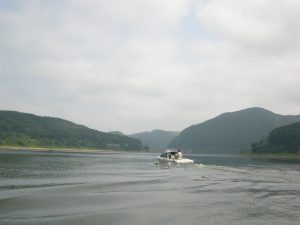
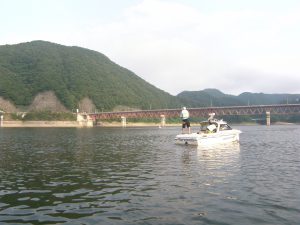
Therefore, an essential first step in environmental research is to visit the actual study site and conduct field observations to understand what is happening in the natural environment.
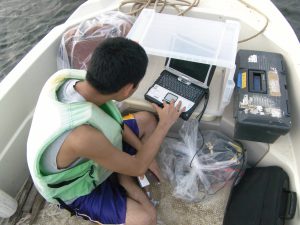
Furthermore, differences inevitably exist between numerical simulations and real environmental conditions. To reliably investigate environmental phenomena using simulations, it is important to verify that these differences are sufficiently small. For these reasons, field observations are an essential part of many of our studies on aquatic environments.
Field Observation Activities