
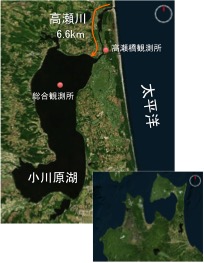
In this study, we investigated a brackish lake where the expansion of a deep, high-salinity water layer has raised concerns about deteriorating water quality. To understand the mechanisms supplying saline water to this deep layer, we aimed to quantitatively evaluate two processes: saltwater intrusion from the sea into the lake through the connecting river and the transport of intruding saltwater into the deep saline water layer. Using our laboratory’s three-dimensional flow simulation model (TITech-WARM), we conducted an integrated numerical simulation covering the entire region from the sea to the lake.
Simulation Results for the River Channel Connecting the Pacific Ocean and the Lake
The colors represent salinity, with red indicating seawater and blue indicating freshwater. The upper graph shows the water levels of the lake (blue line) and the river mouth (red line). When the water level at the river mouth rises above that of the lake due to high tide or other factors, seawater intrudes upstream through the river channel toward the lake.
The three-dimensional simulation allows us to investigate how shallow areas in the middle reaches of the river affect the dilution of intruding saltwater.
Simulation Results for Saltwater Intrusion from the River into the Lake
This figure shows the simulation results for the process by which saltwater, after intruding upstream from the sea through the river, flows into the deeper part of the lake. Saltwater enters from the river on the upper right side and then descends along the lake slope toward the deeper region.
The flow of saltwater along the slope forms a density plume. The extent to which this saltwater is diluted by the surrounding freshwater during its downslope transport is an important factor governing the final amount of saline water stored in the deeper part of the lake.