Tsunami Disaster Mitigation: Development of a Drowning Simulation Model
Drowning is considered to be the leading cause of death during tsunamis. Although rapid evacuation is the most important safety measure, life jackets have attracted attention as a possible secondary measure for situations in which evacuation cannot be completed in time. In fact, some local governments have begun placing life jackets in public facilities.
However, tsunamis are characterized by extremely strong currents. When tsunami waves enter urban areas, buildings and other structures create complex three-dimensional flow patterns. Most commercially available life jackets are designed for ordinary water-related accidents, and it remains unclear whether they can provide sufficient protection against the strong and complex flows generated by tsunamis.
Our laboratory is developing a simulation model called DRUM (DRowning hUman Model), which can simultaneously simulate fluid flow and changes in human body posture and motion. Our goal is to evaluate and improve the effectiveness of drowning prevention measures during tsunamis, including the use of life jackets.
In this simulation model, the human body is represented as a system of rigid body segments, such as the arms and legs, connected by joints. At the same time, the surrounding fluid flow is calculated using three-dimensional numerical simulations. By considering the unsteady hydrodynamic forces acting on the human body and the forces acting at each joint, the model calculates the translational and rotational motions of individual body segments, allowing us to reproduce changes in human body posture underwater.
The animation above shows a simulation of a human body being drawn underwater by a vortex generated behind a structure during a tsunami. The simulation demonstrates that the pressure reduction associated with the vortex can pull the human body beneath the water surface.
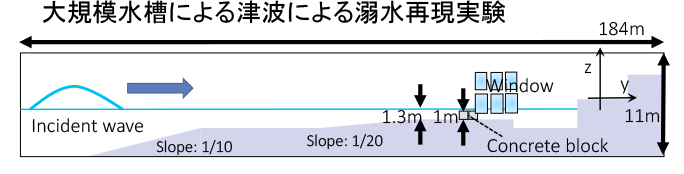
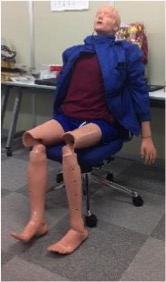
When developing a new simulation model, it is essential to verify whether the model can accurately reproduce experimentally observed phenomena. In this study, we validate the simulation results using experimental data obtained from tests with a human body dummy in a large-scale wave flume. These experiments were conducted by researchers from the Port and Airport Research Institute (PARI) and the Japan Agency for Marine-Earth Science and Technology (JAMSTEC).