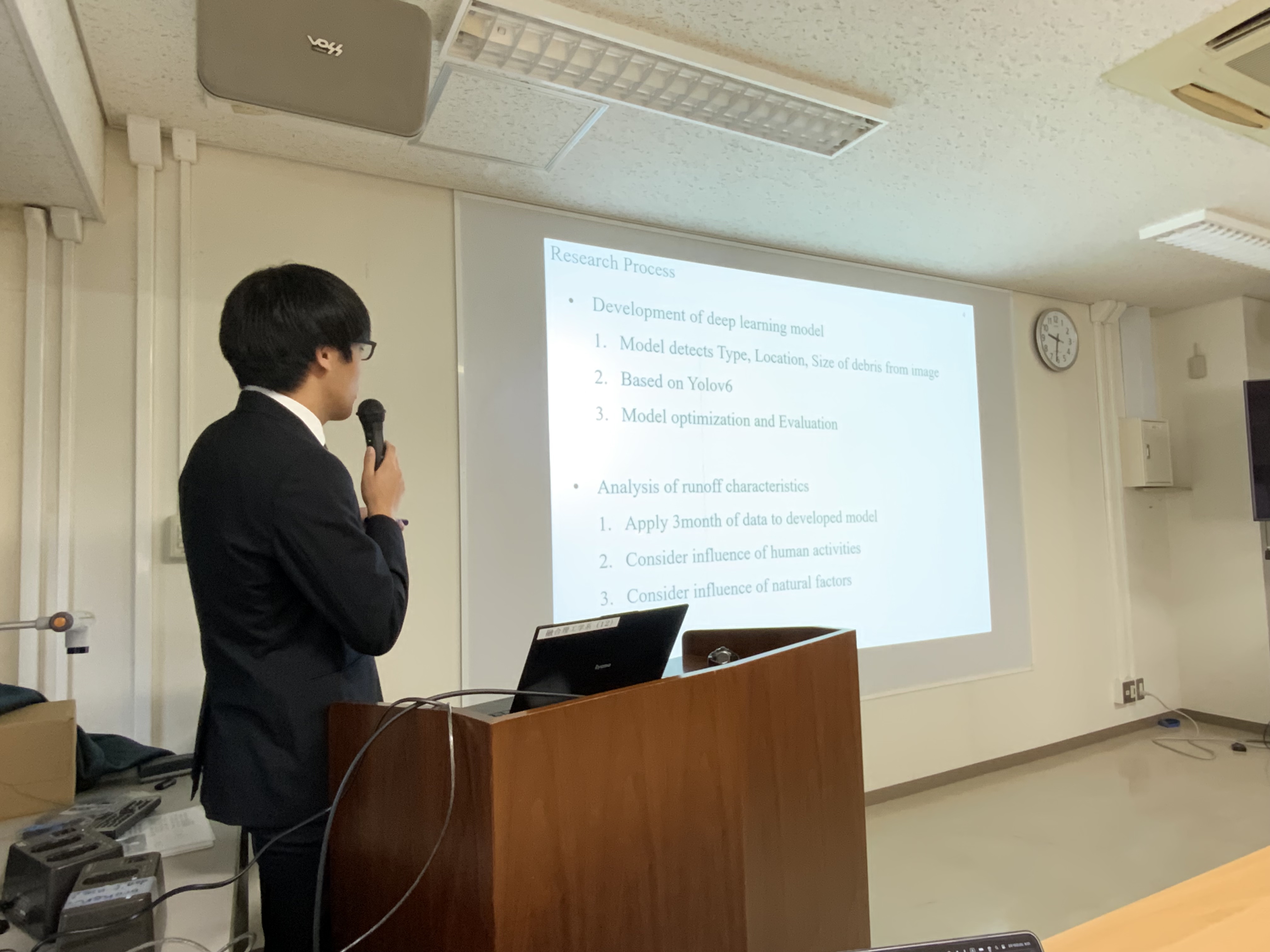
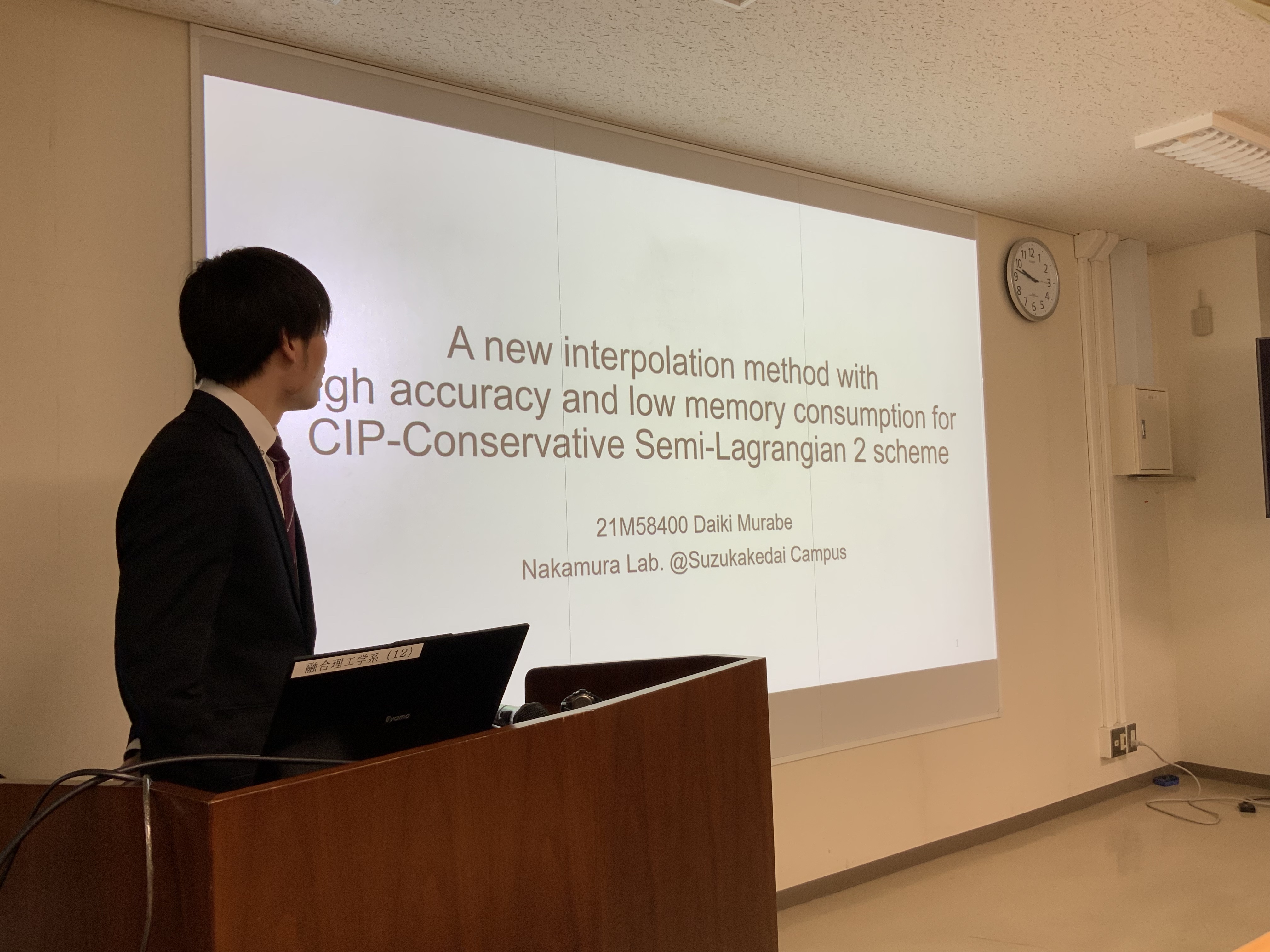
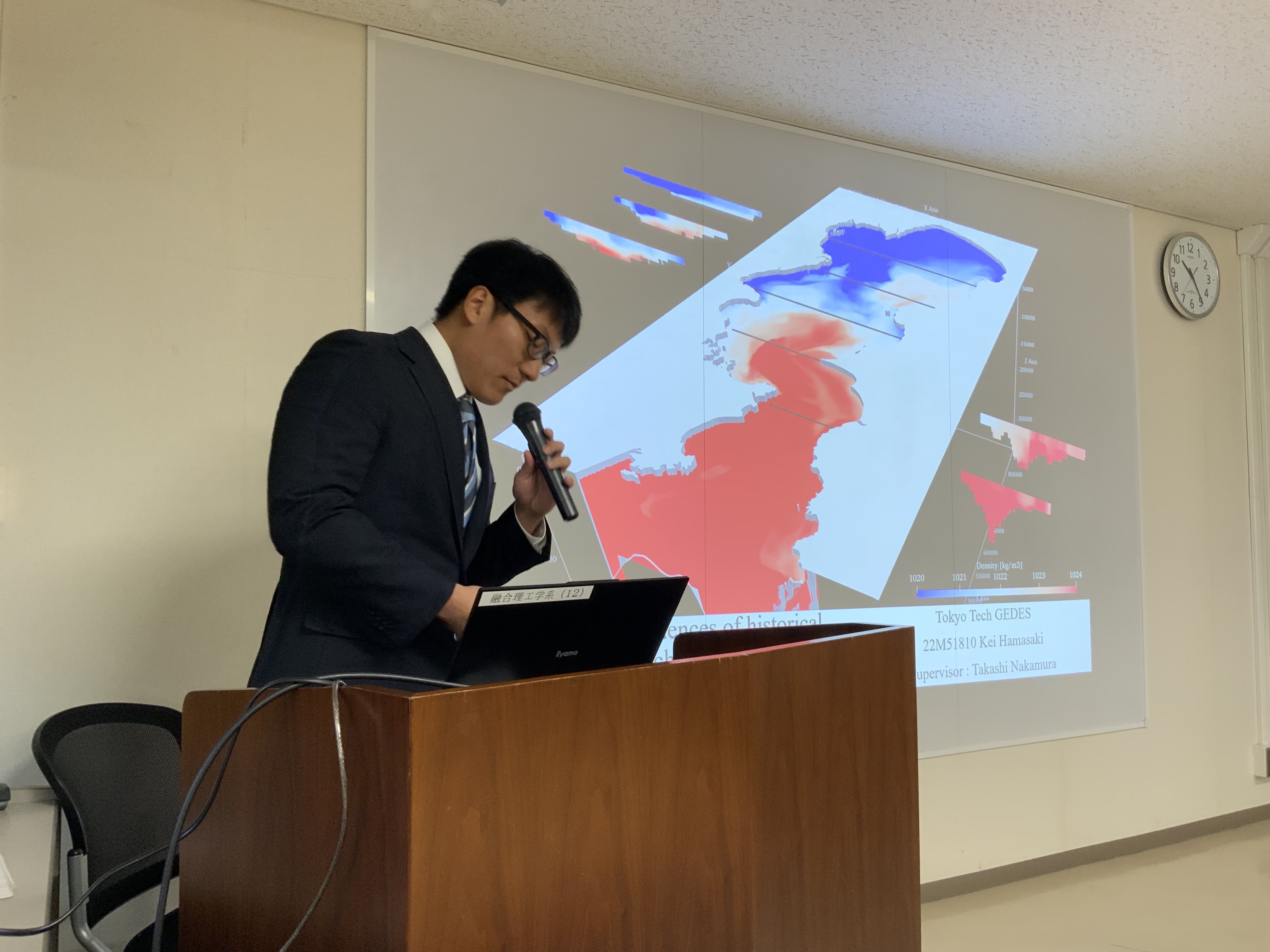
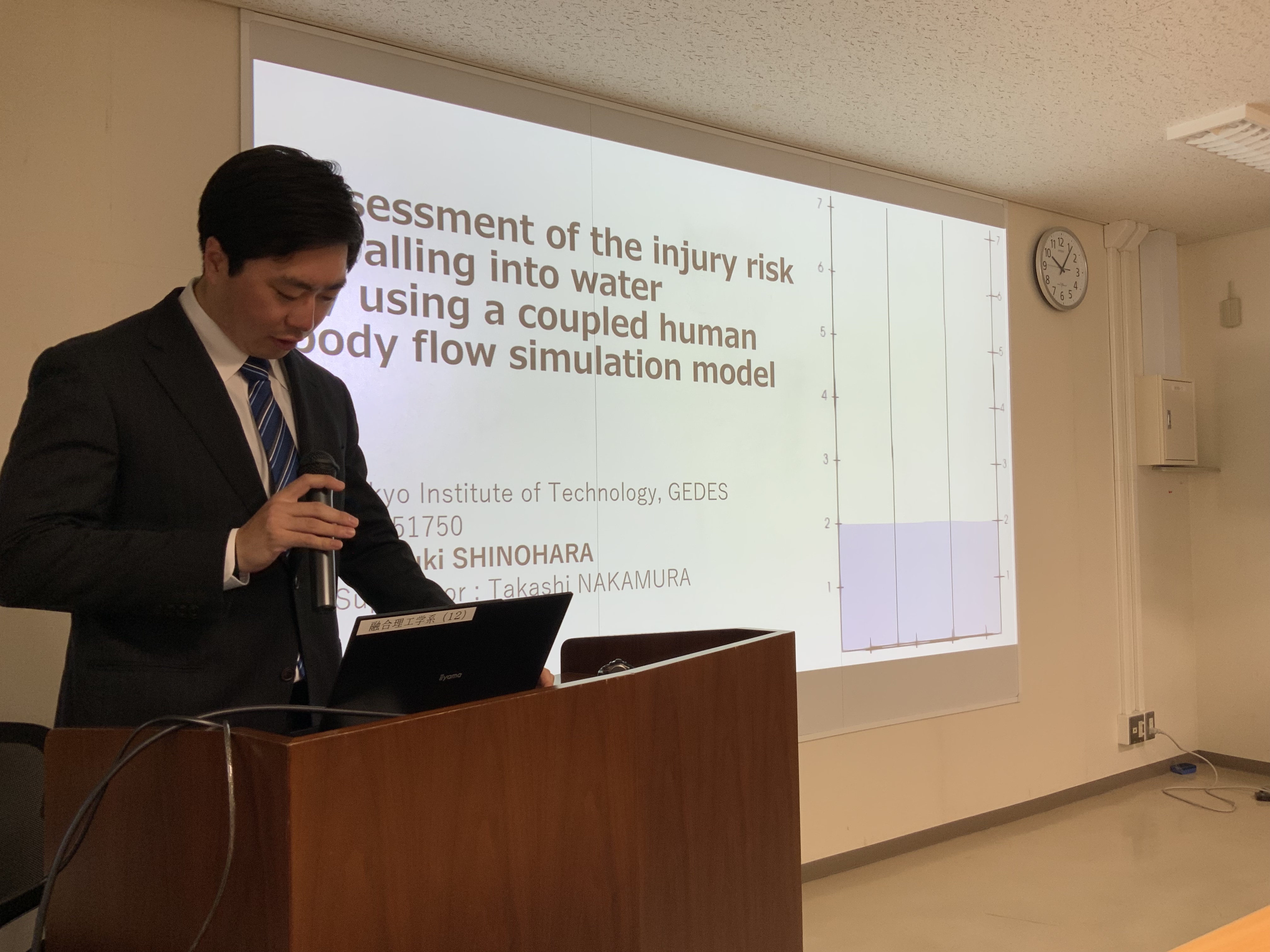
The master’s and undergraduate thesis presentations were held. All students gave excellent presentations and successfully passed their thesis examinations.
Congratulations to everyone!
Nakamura Takashi Lab. @Yokohama, Institute of Science Tokyo
Department of Transdisciplinary Science and Engineering, School of Environment and Society
The master’s and undergraduate thesis presentations were held. All students gave excellent presentations and successfully passed their thesis examinations.
Congratulations to everyone!
Third-year undergraduate students from the Department of Civil and Environmental Engineering participated in hands-on research activities in our laboratory. They worked hard over an extended period, spending one month on discussions and research planning, followed by another month conducting simulations and research.
The students conducted simulations on two topics: “Collisions with Floating Debris During a Mud-Laden Tsunami” and “Effectiveness of Using Plastic Bottles as Improvised Life Jackets During a Tsunami.”
Great work, everyone!
Collisions with Floating Debris During a Mud-Laden Tsunami
・Case of a 50 cm Tsunami Wave Height (Water Content: 600%)
Effectiveness of Using Plastic Bottles as Improvised Life Jackets During a Tsunami
・Without Plastic Bottles
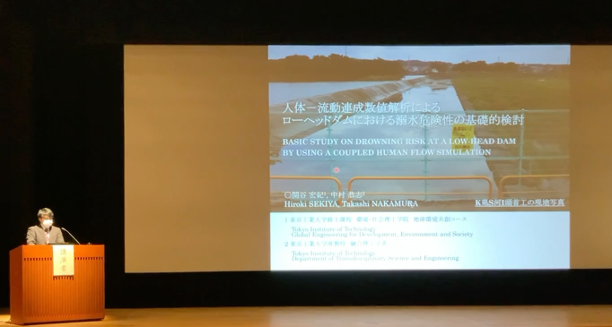
The JSCE Conference on Hydraulic Engineering was held in Matsuyama, Ehime Prefecture. A second-year master’s student from our laboratory presented research findings from numerical simulations assessing the drowning risks associated with recirculating flows downstream of low-head dams.
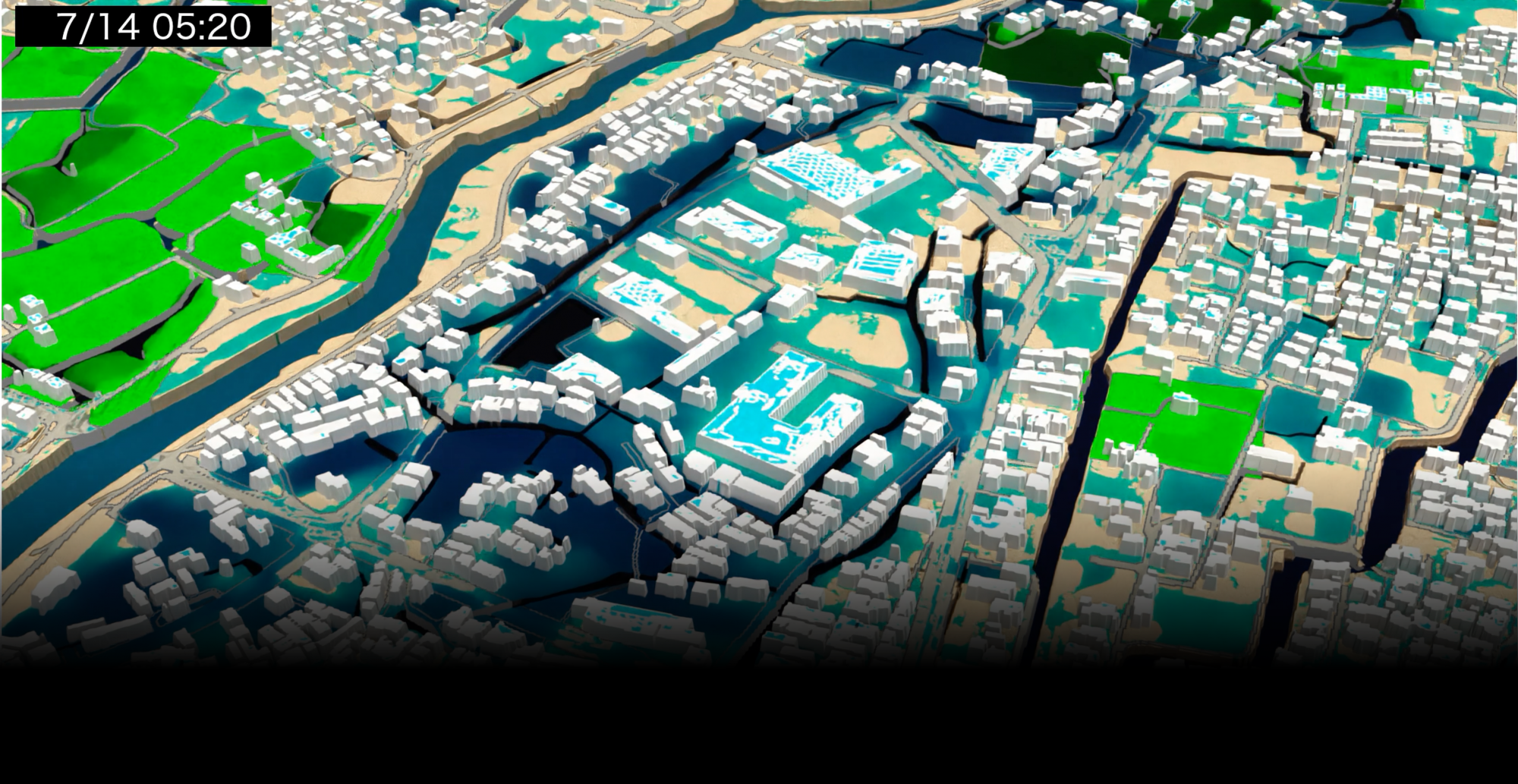
Our laboratory uses ParaView for visualizing numerical simulation results. Since Apple transitioned to its own processors (Apple Silicon), ray tracing had been unavailable in ParaView on Apple computers for some time. Fortunately, with the release of ParaView 5.11.0, ray tracing has become available on Apple Silicon Macs!
The animation below shows the results of a fluid flow simulation of a person running through water. By providing human body motions, such as walking or running, as input data, we can calculate the hydrodynamic forces acting on the body during these movements.
We would like to use this capability to investigate the risks associated with evacuation through flowing water. Unfortunately, however, this research is currently on hold because the student who was working on it has graduated.
We would be very happy if someone were interested in continuing this research!
Third-year undergraduate students visited our laboratory to gain hands-on research experience. The simulations shown below were conducted by the students during their visit.
They worked hard throughout the entire research process, from formulating their own research questions and preparing input data to running the simulations and visualizing the results.
1. Simulation of the Ability of Weir-Like Structures to Prevent Downstream Transport of the Human Body
Case 1: Prone Position (Face-Down)
Case 2: Tucked Position (Knees Drawn to the Chest)
2. Simulation of the Effects of Coastal Topography on Drowning Risks
Case 1: Uniformly Sloping Terrain
Case 2: Coastal Topography with a Reef-Like Formation
We have started a new research project using STOC-LT [1], a simulation model developed by the Port and Airport Research Institute (PARI).
Our goal is to conduct high-resolution simulations of Tokyo Bay, although we are currently learning how to use the model together with our students.
STOC-LT can simulate not only water flow but also water quality and ecological processes. It can even simulate fish!
It is a truly impressive simulation model!
[1] Yoji Tanaka and Kojiro Suzuki (2010), “Development of Non-Hydrostatic Numerical Model for Stratified Flow and Upwelling in Estuary and Coastal Areas,” Report of the Port and Airport Research Institute, Vol. 49, No. 1, pp. 3–25. (in Japanese)
Rivers contain various hydraulic structures, such as weirs, bridge piers, and groynes. These structures help regulate river flow and control water levels, contributing to the effective use of rivers and to flood prevention. On the other hand, a considerable number of water-related accidents in rivers occur around such structures.
In our laboratory, we study various types of river structures and investigate the hazards posed by the complex flow patterns generated around them using coupled simulations of human body motion and fluid flow.
The video below shows a drowning simulation around a groyne conducted as part of an undergraduate research project. Groynes are structures that extend from the riverbank toward the center of the channel in order to reduce the strength of the flow near the bank. However, complex flow patterns with vortices are generated in the wake region behind the groyne. Our research suggests that if a person accidentally falls from a groyne, they may be pulled underwater repeatedly while passing through the vortical flow behind it.
(Played at 3× Actual Speed)
(Close-Up View of the Human Body; Played at 3× Actual Speed)
Our laboratory conducts research to assess the risks associated with water-related accidents. Recently, we have become interested in how differences in body shape affect drowning risks in children, who generally have a larger body surface area relative to their body weight than adults.
The simulation shown below is one of our preliminary tests conducted to verify the accuracy of buoyancy calculations as part of developing a numerical model of a child’s body.
As the graduation season approaches, students in our laboratory are presenting their research findings at their master’s and undergraduate thesis presentation sessions.
Despite the difficult circumstances caused by the COVID-19 pandemic, all of our students have achieved excellent research results.
Great work, everyone!
Third-year undergraduate students visited our laboratory to gain hands-on research experience. The simulations shown below were conducted by the students during their visit.
They simulated a tsunami with a wave height of 10 m, varying the types and arrangements of objects.
Case 1: A Log and a Person
Case 2: A Car, Utility Pole, Bicycle, Furniture, and a Person