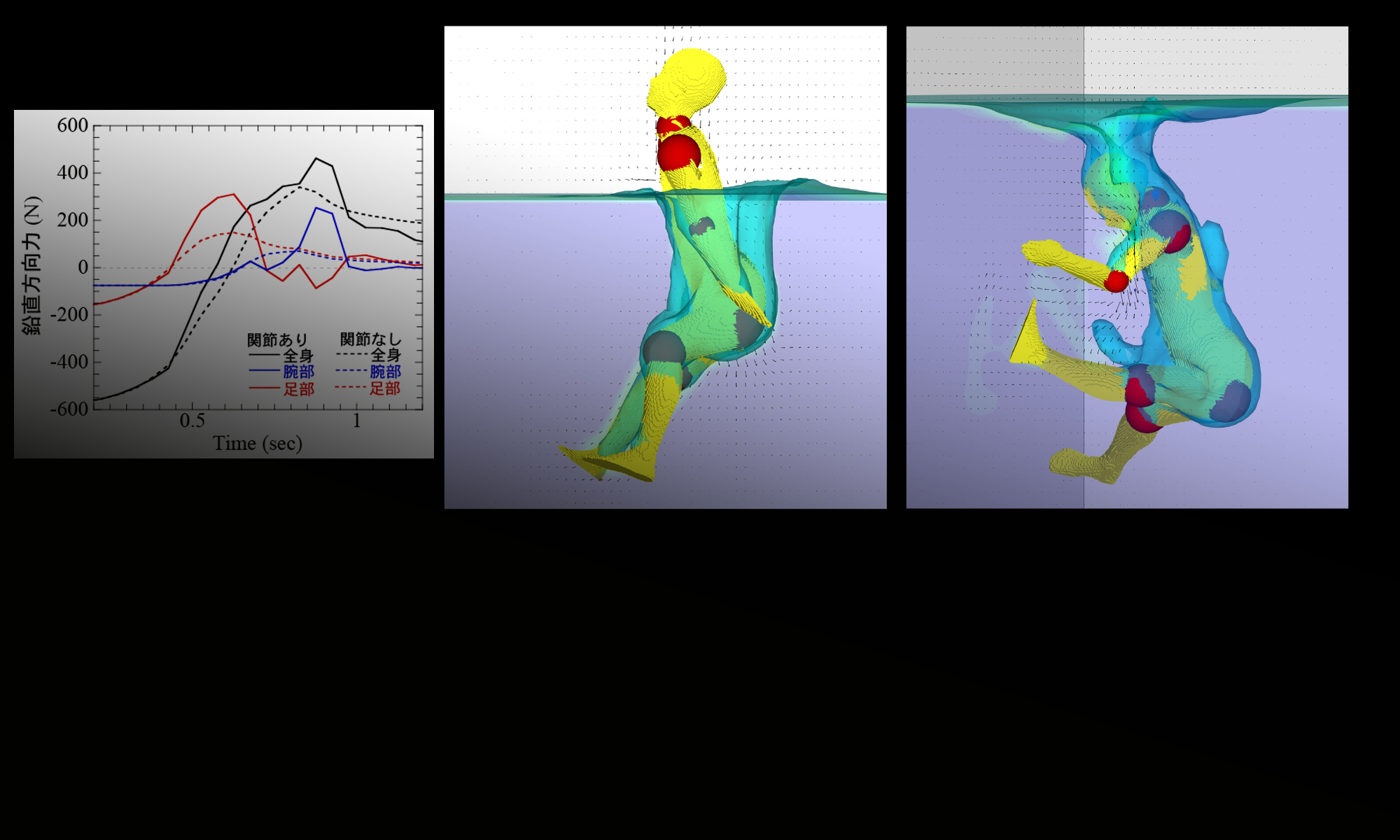
Rivers contain various hydraulic structures, such as weirs, bridge piers, and groynes. These structures help regulate river flow and control water levels, contributing to the effective use of rivers and to flood prevention. On the other hand, a considerable number of water-related accidents in rivers occur around such structures.
In our laboratory, we study various types of river structures and investigate the hazards posed by the complex flow patterns generated around them using coupled simulations of human body motion and fluid flow.
The video below shows a drowning simulation around a groyne conducted as part of an undergraduate research project. Groynes are structures that extend from the riverbank toward the center of the channel in order to reduce the strength of the flow near the bank. However, complex flow patterns with vortices are generated in the wake region behind the groyne. Our research suggests that if a person accidentally falls from a groyne, they may be pulled underwater repeatedly while passing through the vortical flow behind it.
(Played at 3× Actual Speed)
(Close-Up View of the Human Body; Played at 3× Actual Speed)